Decision rules
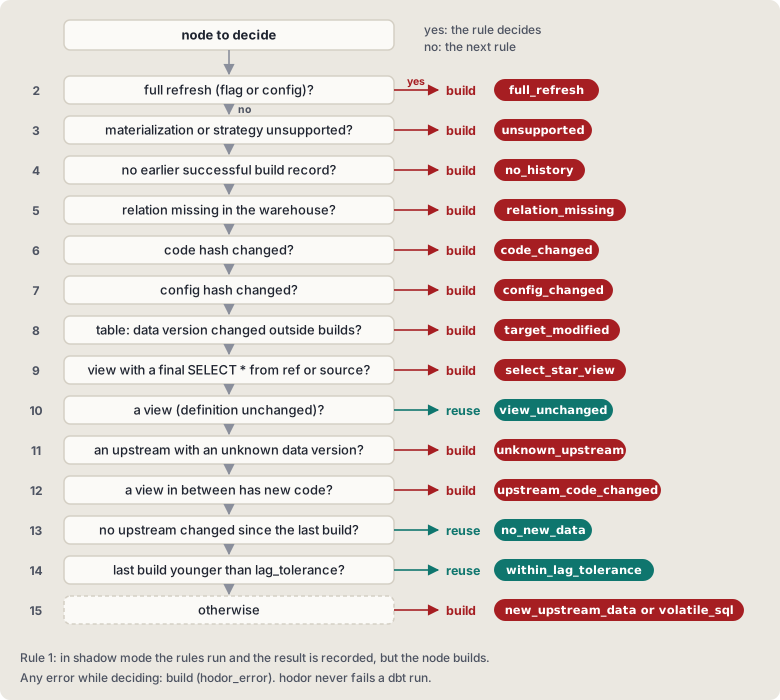
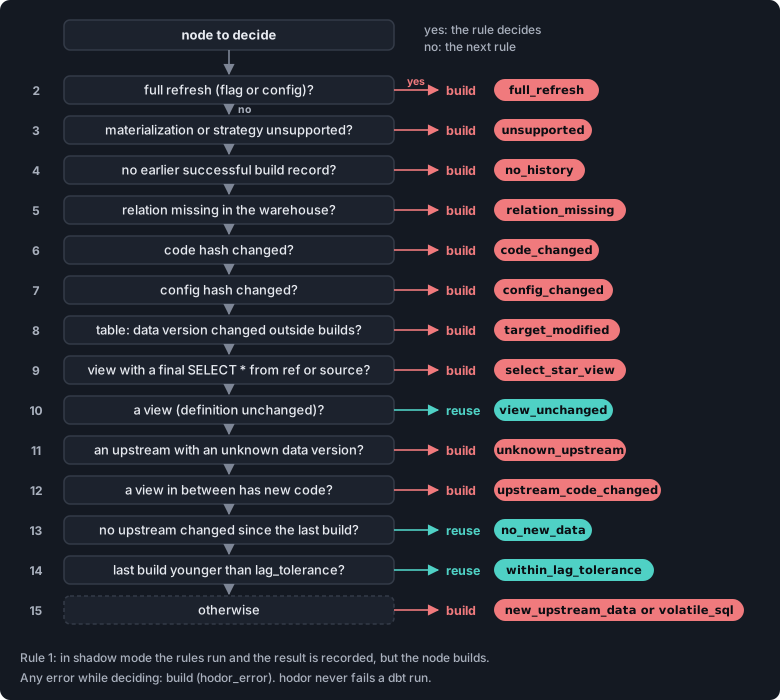
The engine checks the rules in this order. The first rule that matches decides. The reason code goes into the record and the dbt log line.
| # | Condition | Decision | Reason code |
|---|---|---|---|
| 1 | mode is shadow |
build anyway; the record keeps the decision and reason from the other rules | reason from the other rules |
| 2 | --full-refresh, or the node config sets full_refresh: true |
build | full_refresh |
| 3 | resource type, materialization or incremental strategy is out of scope | build | unsupported |
| 4 | no earlier successful build record for this node | build | no_history |
| 5 | the relation is missing from the warehouse | build | relation_missing |
| 6 | the code hash differs from the record (with compare_unrendered_code: rendered and unrendered hashes both differ) |
build | code_changed |
| 7 | the config hash differs from the record | build | config_changed |
| 8 | tables, incrementals and views: the target's data version differs from the one recorded after its last build | build | target_modified |
| 9 | a view whose final SELECT * reads directly from a ref() or source() |
build | select_star_view |
| 10 | the node is a view (its definition is unchanged, see rule 6) | reuse | view_unchanged |
| 11 | any upstream table has an unknown data version | build | unknown_upstream |
| 12 | a view between this node and its upstream tables has other code than at the node's last build | build | upstream_code_changed |
| 13 | no upstream changed since the last build (any), or not all of them changed (all) |
reuse | no_new_data |
| 14 | upstream changed, but the last build is younger than lag_tolerance |
reuse | within_lag_tolerance |
| 15 | otherwise | build | new_upstream_data, or volatile_sql when only volatile values changed |
A failure inside hodor gives hodor_error (build).
Terms
- Upstream changed. An upstream table's current data version differs from the version recorded for it at the node's last build. hodor compares for equality, not order, and the token holds the commit time, so a dropped and recreated table, or one swapped in from a staging table, still counts as changed.
- Last build. The
built_at_msof the latest record with actionbuild. Reuse records do not reset the clock. require_fresh_data_from.anybuilds when any upstream has new data.allbuilds only when all of them have.- Views. A view always shows current upstream data, so new data alone never rebuilds it (rule 10). Rule 10 comes before rule 11, because a view stores no data and an unknown upstream does not make it stale. A view's code hash includes the names of the relations its SQL reads, so a view that reads another relation than at its last build (for example with and without
--defer) builds withcode_changed, also withcompare_unrendered_code. - Views in between. When a node reads through views, the record keeps the code hash of each view. For a view of this target, that is the code hash of its last build. For a base target's view read through
--defer, it is the hash of the view's compiled SQL in the--statemanifest; a view further up is the base target's when this target has no record of it. Both come from compiled SQL, so changes through macros and variables count. If one of them changed, the node builds (upstream_code_changed, rule 12), even when no upstream table has new data, with anylag_toleranceand withrequire_fresh_data_from: all. A view of this target that hodor has no build record of, or a base view without compiled SQL in the manifest, counts as unknown, so the node builds (unknown_upstream). - Seeds and snapshots. Both store their own data, so they follow the table rules, including
target_modified. A seed's code hash is the sha256 of its CSV file, and a seed has no upstream, so it builds only when the file, its config or its table changed. A snapshot's upstreams are the nodes and sources it selects from.lag_toleranceapplies to snapshots too: set it undersnapshots:indbt_project.yml. - Model versions. Each version of a versioned model is its own node, with its own relation (for example
customers_v2) and its own records. A child'sref('customers')compiles to the relation oflatest_version, so movinglatest_versionrebuilds the children withcode_changed. - Volatile SQL. A volatile function whose value decides rows or values (in
WHERE,JOIN, a CTE, or a column computed from other columns) counts as an extra upstream:volatile:date,volatile:sessionorvolatile:always(see Hashing). It goes through the upstream rules (fromunknown_upstreamon) like a table, sowhere d >= current_date() - 7builds once a day, and acurrent_timestamp()filter builds when the last build is older thanlag_tolerance. A new date or user counts as new data even withrequire_fresh_data_from: all. A stamp column, an output column of the finalSELECTthat reads no column (current_timestamp() as _loaded_at), does not count: on reuse it keeps the value of the last build. Views compute these functions when they are read, so they get no volatile upstreams. - Tests. Tests use every rule except the view rules (
select_star_view,view_unchanged) andwithin_lag_tolerance. Their upstreams are the nodes they test.lag_toleranceis always 0 for tests. target_modified. Something wrote to the table outside this node's builds. Maintenance commits such asOPTIMIZEdo not change the data version, so they never trigger it. A view's data version is a hash of its definition in the warehouse, so a view replaced by a run without hodor builds once.
Reason codes in the log
A reused node shows its reason, for example REUSED (no_new_data). A built node shows it too, for example OK (new_upstream_data). A replayed test shows PASS <test> (replayed).